


The earliest traces of wine were discovered in Georgia around 6000 BC, while the first known winery existed in what is now Armenia around 4100 BC. Wine was ever-present in the lives of the Ancient Greeks, while the Romans celebrated their victories by drinking what they called the nectar of the gods.
The tradition of viticulture and winemaking is most deeply rooted in Europe, and France is considered the cradle of great wines. Many of the world’s finest wines originated in the vineyards of Burgundy and Bordeaux, making it unsurprising that, until fifty years ago, the French divided wines into three categories: good wines (French), very good wines (also French), and all others. Looking back from today’s perspective, it is clear that this classification was flawed and reflected the French desire to keep wine prestige exclusively for themselves.
At the same time, wine culture was spreading across other parts of the world. The so-called New World, including the United States, Australia, New Zealand, and others, had already begun producing quality wines that were cautiously appearing on the wine lists of Europe’s finest restaurants, as if waiting for the moment that would change everything.


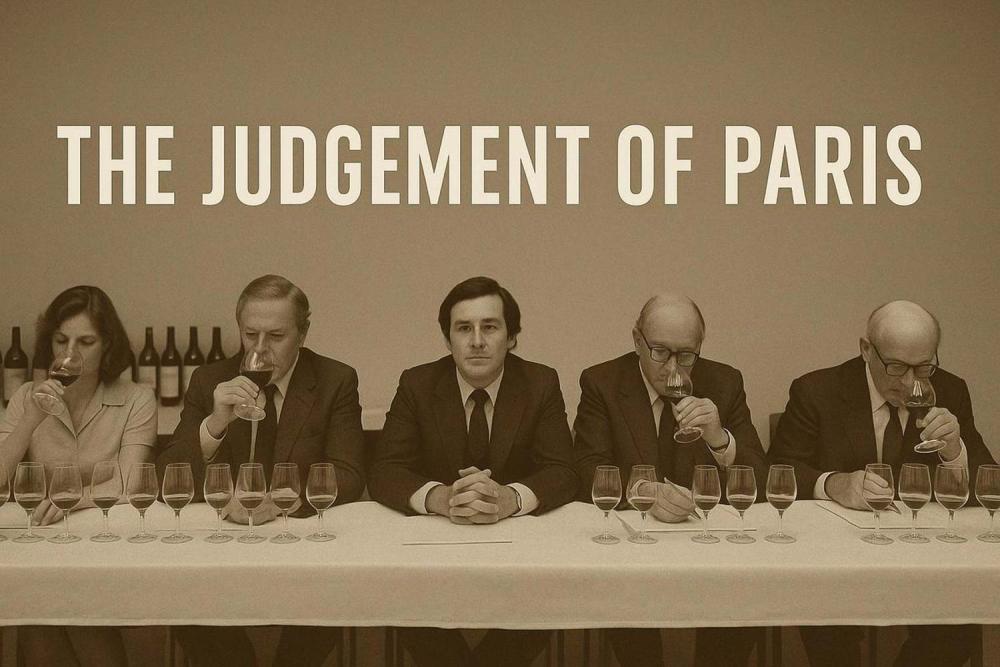
The Judgment of Paris was a landmark event in the history of the wine industry. The competition took place in Paris at the InterContinental Paris Hotel. The blind tasting, held on May 24, 1976, was organized by the respected British wine merchant and educator Steven Spurrier in order to compare wines from California’s Napa Valley with traditional French wines from Bordeaux and Burgundy.
The blind tasting was conducted by a panel of nine French judges consisting of leading sommeliers, critics, and wine experts. The tasting included ten white wines (four Chardonnays from Burgundy and six Chardonnays from Napa Valley, California), as well as ten red wines, including six Cabernet Sauvignons from California and four red wines from Bordeaux.
What happened next was revolutionary. To everyone’s surprise—especially that of the judges—the two winning wines came from Napa Valley: Chateau Montelena Chardonnay 1973 and Stag’s Leap Wine Cellars Cabernet Sauvignon 1973.
The unexpected victories of Chateau Montelena and Stag’s Leap Wine Cellars shocked the wine world. For the first time, wines from California had defeated some of France’s most prestigious châteaux—and, perhaps more importantly, in a blind tasting judged by French experts.
The results attracted international attention and transformed perceptions of American wines. This tasting helped establish the credibility of the Napa Valley region and opened the door for the rise of New World wine regions on the global stage.


Today, the Judgment of Paris is considered a turning point in modern wine history—a moment that demonstrated that outstanding wine can come from many places outside Europe.
The men responsible for this unexpected victory were winemakers Miljenko (Mike) Grgić, creator of the winning Chardonnay while working at Chateau Montelena, owned by Jim Barrett, and Warren Winiarski, founder of Stag’s Leap Wine Cellars.
Miljenko Grgić was born in the village of Desne, near Metković, on April 1, 1923. He studied at the Faculty of Agriculture in Zagreb. In 1954, he emigrated first to Germany, then to Canada, and finally to California, where before joining Montelena he worked in several wineries, including that of Robert Mondavi, the man widely credited with creating the modern American wine industry.
Without any doubt, Miljenko Grgić remains the most important Croatian winemaker of all time. He passed away in 2023 at the age of 101.